

Automotive frontline supervisors: A key role in preventing MSDs
In the automotive industry, and particularly in workshop environments, preventing musculoskeletal disorders (MSDs) is about more than simply adopting the “right” movements. Postures, manual handling and repetitive movements are also influenced by how work is organised and carried out on a daily basis.
This is where automotive frontline supervisors have an important role to play. Working closely with both teams and day-to-day operations, they are well placed to identify what may not always be visible from a distance.
Automotive Frontline Supervisors: Bridging Operations and Business Objectives
The term frontline supervisor covers a range of roles within the automotive industry rather than referring to a single job title. Depending on the company and its organisational structure, this may include a team leader, workshop manager or foreman.
What do they have in common? They oversee and support day-to-day operations, as close as possible to the reality of the shop floor.
Their responsibilities are varied: allocating tasks, ensuring compliance with safety rules and operating standards, monitoring work and interventions, providing technical support, and supporting team members.
In short, the frontline supervisor is both a link between the company’s objectives and the shop floor, and a close observer of day-to-day work. They understand the operational requirements, but they also see how those requirements translate into practice: the constraints employees face, the adaptations they make, recurring difficulties, and the trade-offs made when unexpected situations arise.
This proximity to the shop floor puts frontline supervisors in a strong position to contribute to MSD prevention. So how can they help prevent MSDs before they become a health issue?
Spotting early warning signs… before risks become established
MSDs don’t develop overnight. Accounting for 88% of occupational diseases in France, they can develop gradually as a demanding posture, repetitive movement, poorly managed manual handling or other risk factors become part of the routine of a job.
Yet these early warning signs are often visible well before they result in reported pain or sick leave… provided someone is close enough to the shop floor to spot them.
Some concrete examples:
A technician consistently adopts an awkward posture to access a part. An intervention regularly requires two people to handle a load. An employee develops a “workaround” to overcome a difficulty. A task becomes particularly demanding when the workshop is under pressure.
But spotting these warning signs is not enough if the frontline supervisor has no ability to act on them. Reminding their team to use the “right” movements will not change much if the working conditions themselves remain unchanged.

When production demands come into tension with health
The frontline supervisor is also responsible for meeting production targets, quality standards and cost objectives. When a production line needs to maintain a given pace, changes to a workstation identified as physically demanding may sometimes be postponed:
→ A workstation has been identified as physically demanding for several weeks, but modifications are put on hold until production slows down, to avoid disrupting operations.
→ Conversely, during a peak in orders, an existing job rotation system may be temporarily suspended in order to meet delivery deadlines.
These situations do not necessarily mean that health is deliberately being sacrificed for production. They mainly highlight how difficult it can be to reconcile the two when the room for action is limited.
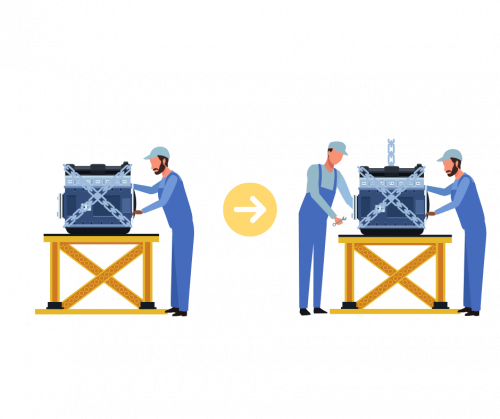
This is where the frontline supervisor’s role becomes particularly important. Can they temporarily reorganise tasks? Arrange for additional support with manual handling? Rotate employees between workstations? Raise a situation they consider problematic?
Preventing MSDs means finding ways to reconcile operational demands with safe and sustainable working conditions.
Giving frontline supervisors the means to take action
To act on what they observe, frontline supervisors need practical resources: time to observe work, opportunities for dialogue with their teams, and a good understanding of MSD risk factors.
These resources are only effective, however, if supervisors also have real room to manoeuvre: the ability to make adjustments to the way work is organised, even on a small scale; recognition from management that prevention is part of their role; and access to the right people to support them, such as QHSE teams, ergonomists, occupational health professionals or employee representatives, depending on the organisation.
In practice, this ability to take action can operate at several levels: work organisation, team support and the collective search for solutions.
- Acting on work organisation. For example, introducing job rotation to limit repeated exposure to the most physically demanding tasks.
- Anticipating risks when work changes. This may include the introduction of a new vehicle or product, a process change, an increase in production rates or a modification to a workstation.
- Adapting prevention instructions to actual working conditions, so that they can be directly applied to situations encountered on the shop floor.
- Providing additional support to new starters and temporary workers, who may be less familiar with the constraints and working practices associated with the job.
- Bringing the people concerned together when a difficulty is identified. For example, through a working group involving employees, frontline supervisors, QHSE representatives and other prevention specialists.
Training and awareness: making prevention part of everyday work
For frontline supervisors to fully play this role, they need support themselves. MSD prevention cannot rely solely on their ability to observe and react.
Training supervisors on the main MSD risk factors, raising awareness among their teams, giving them the means to take action, and establishing clear processes for reporting issues observed on the shop floor all help make prevention part of the company’s day-to-day operations.
After all, a concern raised from the shop floor is only useful if it can be discussed, assessed and, where necessary, lead to changes in working conditions.
Frontline supervisors therefore see both what the company expects and what the work actually requires. This dual perspective enables them to bridge the gap between business objectives and the reality of the workstation : and to identify, on a daily basis, situations that need to be questioned.