


Ageing workforces in the energy sector: rethinking MSD prevention
Musculoskeletal disorders (MSDs) currently account for more than 88% of occupational diseases in France. They affect virtually every sector, profession, gender and age group.
As careers become longer, one question arises: how can we approach occupational health with a long-term perspective?
In the energy sector, this question takes on particular importance: safety requirements remain high, while some interventions take place in physically demanding environments.
The factors that can contribute to MSDs are numerous and may combine with one another: awkward postures, manual handling, difficult access, repetitive movements, exposure to vibration, and more.
The challenge, however, is not to consider ageing workers as a more vulnerable population, but rather to question whether working conditions can remain sustainable over the course of a career.
Preventing MSDs is also about enabling professionals to continue working in demanding occupations while preserving their health, experience and ability to contribute to operational safety over the long term.
Preserving and transferring skills: a challenge for the energy sector of tomorrow
The ageing of the workforce is taking place in a context where several energy sectors are already facing significant recruitment and skills renewal needs.
The demographic picture is clear. Globally, the International Energy Agency (IEA) observes a marked imbalance: there are 2.4 energy sector workers approaching retirement for every new entrant under the age of 25. This ratio rises to 1.7 to 1 in the nuclear sector and 1.4 to 1 in the grid workforce.
As a result, the challenge is not only to prevent work-related health issues. It is also to enable experienced professionals to remain in the workforce under good conditions, at a time when their expertise is essential both to operations and to the transfer of knowledge and skills.
Longer careers therefore invite us to look differently at certain work-related physical demands.
→ A physical demand may be acceptable when it occurs occasionally in a given situation. When the same demand is repeated over many years, its long-term sustainability becomes a different question.
Physical demands that vary significantly across occupations
Working conditions vary considerably across energy sectors: nuclear, electricity generation and distribution, wind, solar, hydropower, grid operations, maintenance, and more.
Work environments, equipment, intervention schedules and physical demands differ from one occupation to another. The following is a non-exhaustive list of physically demanding work situations operators may encounter:
- Working in confined spaces or outdoors: tunnels, foundations, on-site interventions or changing weather conditions;
- Equipment located at height or at ground level: working from a lift platform, overhead work with arms raised or, conversely, tasks requiring work close to the ground;
- Manual handling and lifting: moving tools, parts or equipment, sometimes in areas with limited access;
- Awkward postures: bending, twisting, working with arms above shoulder level, kneeling or squatting;
- Confined or difficult-to-access environments: restricted spaces, complex access points or the need to maintain a fixed posture throughout an intervention;
- Repetitive movements: repeating the same movement or repeatedly placing strain on the same part of the body during an intervention.
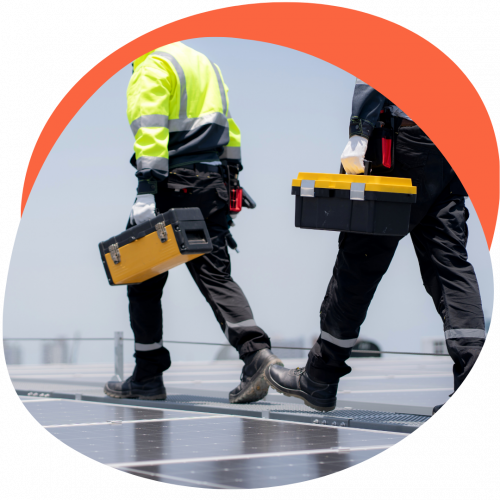
Reducing physical demands without compromising standards
Across these occupations, prevention cannot come at the expense of safety requirements or the realities of the work.
Installation or maintenance operations must still be carried out under the required conditions, with the expected level of rigour and reliability. The challenge is therefore not to eliminate every physical demand, but to distinguish between those that are inherent to the activity and those that can be reduced or avoided.
This can involve very practical measures: improving access to equipment, reducing unnecessary handling, choosing the right tool, repositioning an element, using mechanical handling aids or changing the way an intervention is organised.
When a physical demand cannot be eliminated, other measures can be considered: task rotation, changes to how interventions are organised, recovery time or appropriate adjustments.
Ultimately, prevention should not rely solely on the worker’s ability to “cope with” the physical demands of the job. Work design, equipment and organisation can also play a role in reducing physical strain.
Turning experience into a prevention tool
Opening the dialogue about real-life work situations
- Which intervention, task or activity places the greatest physical demands on you?
- What have you learned to do differently with experience? And what would you have liked to be able to do differently?
- What could be improved without changing the safety requirements?

When we think about preventive or corrective measures, we often first consider equipment, procedures or workplace adjustments. Yet some of the answers may already lie in the experience of those who carry out these interventions on a daily basis.
Over the years, professionals develop strategies, adaptations and practical workarounds to deal with the physical demands of their work. Listening to them helps build a better understanding of these situations, identify what could be improved and, in some cases, bring to light simple solutions that can be implemented directly.
In a context where energy sectors need to renew their skills, this feedback takes on particular importance. Protecting experienced professionals also means preserving and passing on part of the company’s know-how.
Conclusion
Sources :
Ameli – Les TMS, pourquoi et comment agir https://www.ameli.fr/entreprise/sante-travail/risques/troubles-musculosquelettiques-tms/pourquoi-comment-agir
IEA – L’emploi dans le secteur de l’énergie a connu une forte hausse, mais la pénurie croissante de main-d’œuvre qualifiée menace la dynamique future https://www.iea.org/news/energy-employment-has-surged-but-growing-skills-shortages-threaten-future-momentum
Morken, Tone & Mehlum, Ingrid & Moen, Bente. (2006).Troubles musculo-squelettiques liés au travail dans le secteur pétrolier offshore en Norvège. https://www.researchgate.net/publication/6574430_Work-related_musculoskeletal_disorders_in_Norway’s_offshore_petroleum_industry
Velasco Garrido, M., Mette, J., Mache, S. et al. Douleurs musculo-squelettiques chez les travailleurs du secteur de l’éolien en mer : une étude transversale. https://link.springer.com/article/10.1007/s00420-020-01544-3