


Equipment Operators and MSDs: vibrations, postures and prevention
According to the French National Health Insurance Fund, 91% of recognized occupational diseases in the construction sector are musculoskeletal disorders (MSDs). Equipment operators are among the occupations particularly at risk due to prolonged exposure to vibrations and postural constraints.
Between vibrations, uneven ground conditions, and long hours spent in the cab, physical stresses can accumulate and have lasting effects on health.
How do these constraints affect the body? What are the associated risks, and what prevention measures can help reduce them?
Vibrations: what are we talking about?
In the construction industry, many types of equipment generate mechanical vibrations, defined as oscillations transmitted to the human body when in contact with a machine, tool, or vehicle. This transmission can occur through the hands, feet, or, in the case of equipment operators, through the cab.
Two main types of exposure can be distinguished:
1. Hand-arm vibrations (hand-guided portable tools)
These occur when using portable tools such as jackhammers, grinders, rammers, and concrete breakers.
2. Whole-body vibrations (vehicle and equipment operation)
These mainly affect construction equipment operators (excavators, loaders, bulldozers, compactors, dumpers, etc.). Their intensity varies depending on several factors: ground conditions, travel speed, type of equipment used, seat quality and suspension system, equipment maintenance, and daily exposure time.
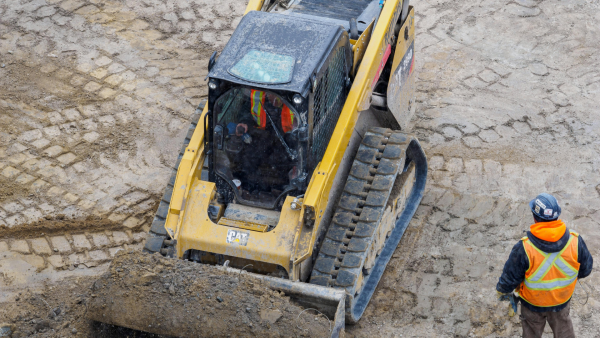
Throughout the working day, equipment operators may spend several hours seated in their cab, often on uneven ground, while carrying out tasks that require constant attention and frequent trunk and neck rotations.
The case of construction equipment operators:
Vibrations are a recognized risk factor, but they never act alone. MSDs are multifactorial: the combination of vibrations and postural constraints contributes to a high level of risk, without excluding other aggravating factors.
In equipment operators, the observed injuries mainly result from compression and shear forces, which are worsened by prolonged sitting.
Additional stresses come from trunk twisting and stretching movements, performed by operators to monitor their manoeuvres or reach controls. These movements become even more damaging to the back when vibration intensity is high or when shocks occur.
This combined exposure — to both vibrations and postural constraints — partly explains why equipment operators have a particularly high risk of developing low back pain and other spinal disorders.
The conditions most commonly associated with equipment operation:
→ Low back pain: pain located in the lower back.
→ Herniated discs: a condition that occurs when the outer layer of an intervertebral disc cracks or ruptures, allowing the disc’s inner core to compress a nerve root.
→ Sciatica: pain that follows the path of the sciatic nerve, from the lower back down to the back of the thigh and leg.
→ Cruralgia : pain that follows the path of the femoral nerve, from the lower back to the front of the thigh, sometimes extending to the knee.
Risk assessment focus
The main steps:
- Identify exposed workstations
- Determine daily vibration exposure levels and exposure duration
- Compare the recorded values with the action and limit values set by regulations
What regulations say about whole-body vibration exposure:
- The daily exposure action value: 0.5 m/s² — above this level, employers must implement preventive measures
- The exposure limit value (ELV): 1.15 m/s² — a threshold that must never be exceeded
Preventing MSDs, step by step
Preventing MSDs among equipment operators involves three key stages: before the construction site begins, during operation, and afterwards through monitoring and maintenance.
To be effective, prevention must combine technical, organizational, and individual measures, implemented before, during, and after equipment use.
Before: Reducing vibrations at the source
→ Surfaces and equipment selection:
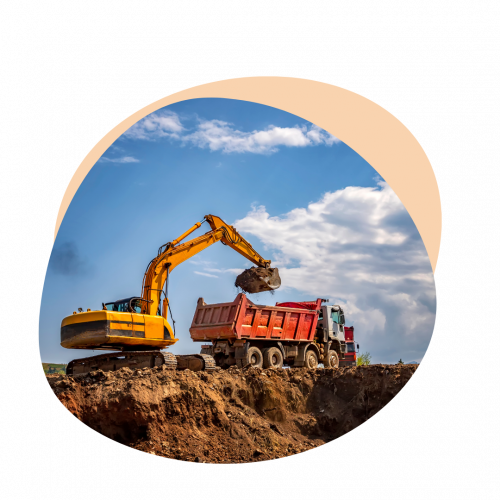
It’s rarely possible to achieve perfectly flat surfaces on a construction site. However, whenever possible, grading access roads and travel paths helps reduce shocks and vibrations transmitted to the cab. Choosing equipment that is suited to the ground conditions and fitted with vibration-reducing systems is therefore an important preventive measure.
When purchasing or renting equipment, it’s recommended to check the vibration emission value provided by the manufacturer and compare different models in order to select the equipment best suited to the needs of the worksite.
→ Tyres: Tyres that are in good condition, properly inflated, and suited to operating conditions help reduce vibration transmission.
→ Suspension systems: Suspension systems play a key role in absorbing vibrations. Choosing a low-frequency suspension system at the chassis or cab level, combined with a properly adjusted suspension seat adapted to the operator’s body shape, helps reduce the stresses transmitted to the operator.
During : Good driving practices
Prevention also relies on daily habits and good practices.
→ Driving posture: Optimizing the operator’s posture helps reduce risks. Proper seat and workstation adjustments are essential to limit the occurrence of certain shocks.
→ Adapt driving speed: Vibration exposure is increased when driving off-road or on uneven surfaces, especially at higher speeds.
→ Limit trunk and neck twisting: Operators often turn around to monitor their work or lean forward to reach controls, exposing the back to harmful twisting and stretching movements. Equipment solutions are available to reduce these stresses (rear-view mirrors, reversing or detection cameras, swivel seats, etc.).
→ Avoid unnecessary shocks;
→ Schedule breaks and alternate tasks;
→ Individual exposure monitoring: The OSEV tool, developed by the INRS, helps estimate an operator’s daily exposure to whole-body vibrations. It provides valuable support for identifying risk situations and adapting work organization.
After the construction site: Maintaining equipment and identifying early warning signs
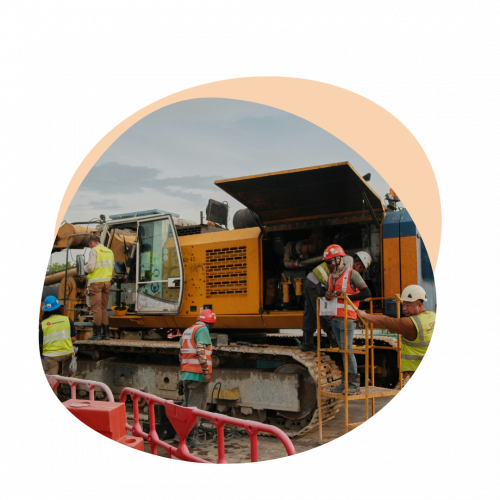
At the end of each worksite operation, equipment maintenance helps preserve the performance of suspension systems and limit the occurrence of excessive vibrations. It’s also the right time to report any issues (faulty seat, worn suspension system, damaged tyres).
From the operator’s perspective, any persistent pain in the back, shoulders, or lower limbs should be reported without delay. Early management can often help prevent the development of chronic disorders.
A collective responsibility to drive prevention
When addressing MSD risks among construction equipment operators, the focus is often placed on the operator themselves: their posture, equipment settings, and driving habits. However, MSD prevention does not rely solely on the individual operator : the entire work team has a key role to play.
A chain of responsibilities, not a single link
- The employer, who must organize prevention efforts, inform employees about risks, and prioritize collective protective measures before individual protection measures,
- Supervisors and technical managers, who report site constraints and adapt work organization,
- Operators themselves, who should be involved in developing solutions rather than simply acting as task executors,
- External stakeholders (occupational health services, Carsat, OPPBTP) who provide technical and methodological support.
In conclusion…
MSDs among equipment operators are not an inevitable consequence of the job, but rather the result of a combination of factors: vibration exposure, prolonged postures, constraints related to manoeuvres, worksite conditions, and work organization.
Effective prevention therefore relies on a comprehensive approach: acting on the equipment, improving operating conditions, adapting work organization, and involving all worksite stakeholders.
However, preventing MSDs also means being able to identify risk situations before pain becomes established. Observing actual work practices, analyzing physical constraints, and detecting risk factors at an early stage make it possible to take action proactively by implementing solutions adapted to real working conditions.
Start your MSD prevention approach today with KIMEA!
Sources :
Améli – Bâtiment https://www.ameli.fr/entreprise/sante-travail/risques/troubles-musculosquelettiques-tms/secteur-activite/batiment
INRS – Vibrations plein le dos, conducteurs d’engins mobiles https://www.inrs.fr/media.html?refINRS=ED%206283
INRS – Vibrations transmises à l’ensemble du corps https://www.inrs.fr/risques/vibration-corps-entier/effets-sante.html
Prévention BTP – Les vibrations mécaniques dans le BTP
Travail Emploi Gouv – Les risques liés aux vibrations mécaniques
https://travail-emploi.gouv.fr/les-risques-lies-aux-vibrations-mecaniques