


Focus on a MSD #6 – De Quervain’s tenosynovitis
Today, we’re taking a closer look at a musculoskeletal disorder (MSD) that is often overlooked compared with other wrist and hand conditions: De Quervain’s tenosynovitis.
This MSD affects the tendons at the base of the thumb and can make everyday tasks as well as work-related activities painful and difficult.
In this new MSD focus, we’ll explore how this condition develops, its symptoms and risk factors, as well as the key approaches to prevention and treatment.
What is De Quervain’s tenosynovitis?
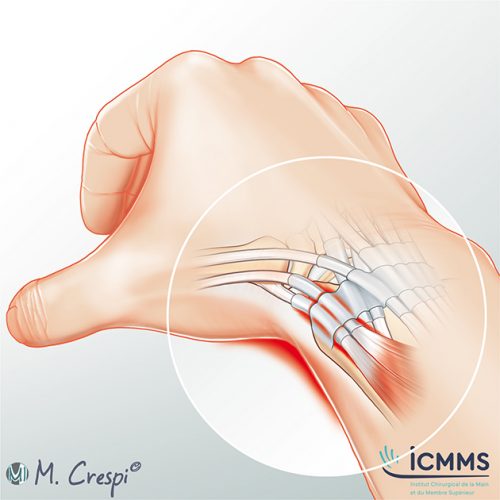
Source : ICMMS
De Quervain’s tenosynovitis is a condition characterized by inflammation and swelling of the tendons, or their surrounding sheath, at the base of the thumb.
It affects two tendons that are essential for thumb movement: the abductor pollicis longus (APL) and the extensor pollicis brevis (EPB). These tendons enable the thumb to move away from the hand and play a key role in gripping, pinching and grasping movements.
The condition is named after the Swiss surgeon Fritz de Quervain, who first described it in 1895.
Spotlight: Understanding the different hand and wrist syndromes
Several musculoskeletal disorders can affect the hand and wrist:
→ De Quervain’s tenosynovitis: affects the tendons at the base of the thumb, causing pain during gripping, pinching and grasping movements.
→ Carpal tunnel syndrome: compression of a nerve at the wrist that can cause tingling, numbness and loss of sensation in the fingers.
→ Guyon’s canal syndrome (also known as ulnar tunnel syndrome): compression of a nerve at the wrist (on the little finger side), leading to sensory and/or motor disturbances in some fingers.
There is limited precise epidemiological data on De Quervain’s tenosynovitis, which explains the relatively small number of available figures.
In France, a study conducted among 3,710 employees between 2002 and 2005 estimated a prevalence of 1.2% in the working population, with a higher frequency in women (2.1%) than in men (0.6%).
De Quervain’s tenosynovitis: Symptoms
The main symptom of De Quervain’s tenosynovitis is pain located on the outer side of the wrist, at the base of the thumb. It usually develops gradually and becomes worse during movements that involve the thumb or wrist.
People affected may experience:
- pain at the base of the thumb, which may radiate towards the forearm;
- discomfort during gripping, pinching or twisting movements (such as opening a jar, wringing out a cloth, or using a screwdriver);
- swelling or tenderness when pressing on the base of the thumb, and sometimes a feeling of stiffness.
Without appropriate management, the pain may gradually worsen and limit both daily activities and certain work-related tasks.
De Quervain’s tenosynovitis: Causes
De Quervain’s tenosynovitis is a multifactorial condition: there is no single cause, but rather a combination of factors that increase the mechanical load on the tendons of the thumb.
In both occupational and daily life contexts, certain movements or situations may contribute to its development:
→ repetitive movements involving the thumb and wrist;
→ strong gripping or pinching efforts, particularly when using hand tools;
→ wrist twisting movements;
→ prolonged awkward or constrained wrist postures;
→ lack of recovery time during repetitive activities.
Other factors may also increase the risk of developing this condition, such as anatomical variations, pregnancy, or certain inflammatory diseases.
Prolonged exposure to several of these factors increases the risk of developing the condition, which highlights the importance of appropriate prevention strategies.
Occupational context
De Quervain’s tenosynovitis is listed under occupational disease schedule No. 57 in the French general social security system. Recognition as an occupational disease depends in particular on a defined latency period between the end of exposure to risk and the onset of symptoms, as well as the type of work performed.
Beyond workers and tradespeople handling vibrating or heavy tools, several sectors are particularly exposed to repetitive and precise thumb movements:
- office and administrative work, due to intensive use of a mouse and keyboard;
- hairdressing, involving repeated gripping and twisting movements;
- laboratory work, particularly through the use of pipettes;
- sewing and garment manufacturing;
- music, as certain instruments place significant demands on the thumb;
- manual handling and material handling tasks.
More recently, intensive use of screens, smartphones and gaming controllers has also been identified as a source of thumb overuse, including outside the strictly occupational context.
De Quervain’s tenosynovitis: Diagnosis
Diagnosis is primarily based on a clinical examination performed by a healthcare professional. The clinician typically looks for:
→ pain located at the base of the thumb, on the outer side of the wrist, which is triggered or worsened by certain movements.
→ tenderness when pressing on the affected area.
The clinician may also perform specific tests, such as the Finkelstein test, which helps support the diagnosis when it reproduces the pain.
An ultrasound scan may also be used to assess tendon thickening.
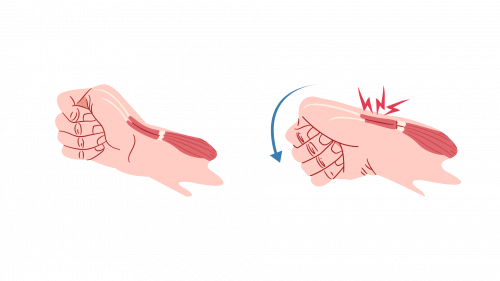
The Finkelstein test involves applying tension to the tendons of the thumb in order to replicate the characteristic pain associated with De Quervain’s syndrome.
De Quervain’s tenosynovitis: Treatment
Treatment depends on the severity of symptoms and their progression. In most cases, conservative management is effective in relieving pain. It may include:
- relative rest and reduction of painful movements;
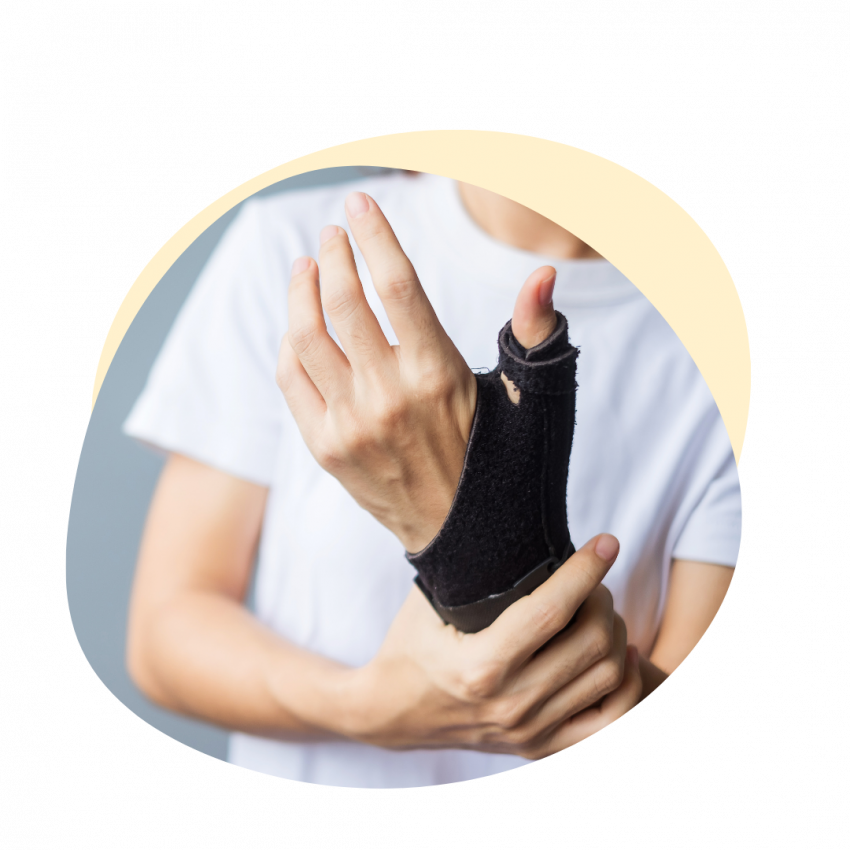
- wearing a splint to limit thumb and wrist movement;
- pain-relief or anti-inflammatory medication, depending on the healthcare professional’s advice;
- rehabilitation sessions may be prescribed once inflammation is under control.
When symptoms persist despite these measures, a corticosteroid injection may be considered.
In rarer cases, surgery may be recommended to release the tendon compartment and improve tendon gliding.
Preventing De Quervain’s tenosynovitis
As with all musculoskeletal disorders, prevention of De Quervain’s tenosynovitis relies primarily on analysing work situations in order to identify mechanical stresses affecting the thumb and wrist.
Several measures can be implemented:
→ limiting repetitive movements;
→ reducing gripping and pinching efforts, particularly through the use of appropriate tools or equipment;
→ alternating tasks to reduce sustained repetitive strain on the same structures;
→ introducing adequate recovery time.
In summary…
Often overshadowed by carpal tunnel syndrome, De Quervain’s tenosynovitis is nonetheless a musculoskeletal disorder in its own right, capable of significantly limiting simple everyday actions such as grasping an object or turning a key.
The good news is that it can be prevented !
At Moovency, we help companies prevent musculoskeletal disorders (MSDs) through KIMEA and the expertise of our ergonomists. With our assessment tools, you can easily identify the most strained joints and implement targeted prevention measures. This helps minimize the risk of neck pain in the workplace and maintain the well-being of your employees.
Sources :
ICMMS – Ténosynovite de De Quervain https://www.icmms.fr/tenosynovite-de-quervain#:~:text=Description%20de%20la%20pathologie,du%20bord%20radial%20du%20poignet.
Institut Main – Tendinite de Quervain https://institut-main.fr/tendinite-de-quervain/
MSD Manuals – Maladie de De Quervain https://www.msdmanuals.com/fr/accueil/troubles-osseux-articulaires-et-musculaires/maladies-de-la-main/maladie-de-de-quervain
Petit Le, Audrey & Roquelaure, Yves & Ha, Catherine & Bodin, Julie & Meyer, Geraldine & Bigot, Frédéric & Veaudor, Martin & Descatha, Alexis & Goldberg, Marcel & Imbernon, Ellen. (2011). Risk factors for de Quervain’s disease in a French working population. Scandinavian Journal of Work, Environment & Health – https://www.sjweh.fi/show_abstract.php?abstract_id=3160