


PAPRIPACT : The complete guide
In the field of occupational health and safety, the DUERP (Single Document for the Assessment of Occupational Risks) is a well known document that identifies, analyzes, and evaluates workplace risks within an organization. But are you familiar with the PAPRIPACT? This document is complementary and inseparable from the DUERP, and is essential for structuring concrete and effective prevention actions.
In this article, we present everything you need to know about the PAPRIPACT, including its definition, legal framework, typical structure, and a practical example to help you implement it effectively.
PAPRIPACT : Brief Definition
The French acronym PAPRIPACT stands for “Programme Annuel de Prévention des Risques Professionnels et d’Amélioration des Conditions de Travail,” meaning Annual Program for the Prevention of Occupational Risks and the Improvement of Working Conditions.
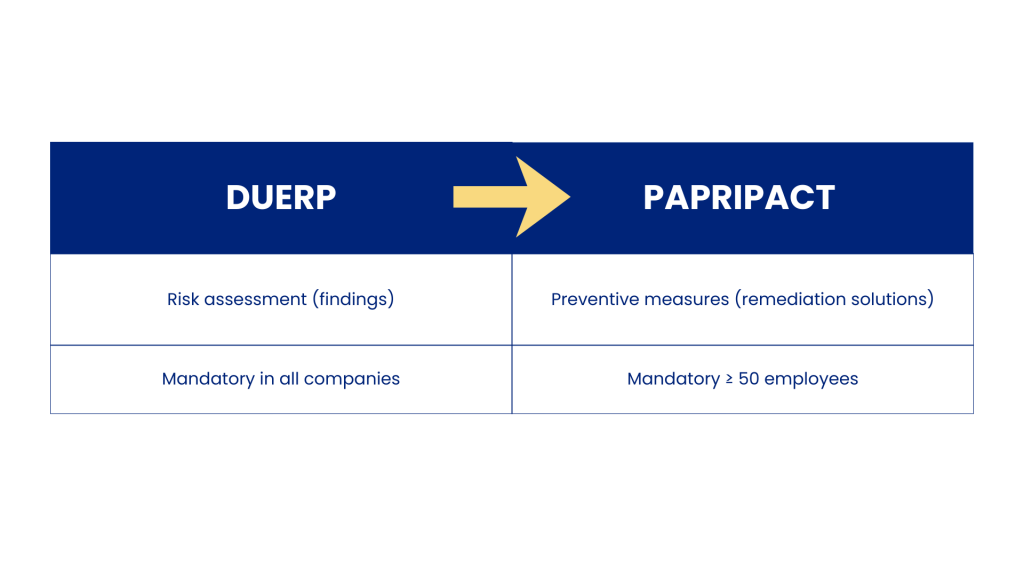
In France, it is a mandatory document for organizations with at least 50 employees. Its purpose is to formalize a structured annual action plan designed to prevent and reduce previously identified occupational risks.
From DUERP to PAPRIPACT
PAPRIPACT : The regulatory framework
General regulatory framework
The PAPRIPACT falls within the general obligations related to occupational risk prevention as defined by the French Labour Code.
In practical terms, when a company reaches or exceeds a workforce of 50 employees, the results derived from the DUERP must lead to the development of an Annual Program for the Prevention of Occupational Risks and the Improvement of Working Conditions (PAPRIPACT). The objective is clear: to transform risk assessment into a structured action plan that is planned, implemented and monitored over time.
In companies with fewer than 50 employees, the underlying prevention approach remains the same, but the level of formalization is lighter. The employer must define a list of prevention and employee protection measures, integrated directly into the DUERP and updated regularly. Therefore, the formal implementation of a PAPRIPACT is not mandatory, although some organizations voluntarily choose to adopt its framework in order to structure their prevention strategy.
The Social and Economic Committee (CSE) plays a central role in the development of the PAPRIPACT. As part of the annual consultation on the company’s social policy, the PAPRIPACT must be submitted to the CSE for review and opinion (Article L2312-27 of the French Labour Code).
Reminder: the CSE is mandatory in companies with at least 11 employees; however, the obligation to present the PAPRIPACT to the CSE applies only to companies with 50 employees or more.
Employer obligations and legal responsibility
The PAPRIPACT is a document prepared under the responsibility of the employer. Failure to comply with occupational risk prevention obligations may result in civil liability and, in certain cases, criminal liability, particularly in the event of a workplace accident or a proven breach of the employer’s duty to ensure the health and safety of employees.
Like the DUERP, the PAPRIPACT is also a key tool for social dialogue. Employee representatives must be informed and consulted on the annual prevention program. Preventing this consultation from taking place or obstructing the proper functioning of the Social and Economic Committee may constitute an obstruction offense, which can be punishable by a fine of up to €7,500.
PAPRIPACT : Content and structure
There is no mandatory template for the PAPRIPACT. However, it is recommended to adopt a format that is clear, simple, structured, and easy to understand for all stakeholders. An Excel spreadsheet or any well-organized document is often sufficient to ensure proper monitoring and readability.
In accordance with Article L4121-3-1 of the French Labor Code, the PAPRIPACT must notably:
→ define a detailed list of the measures to be implemented over the coming year, including actions aimed at preventing exposure to occupational risk factors.
For each measure, the program must specify:
-
the implementation conditions
-
performance indicators or expected results
-
the estimated cost
→ identify the internal resources that can be mobilized within the company;
→ include a clear implementation timeline or schedule.
Example concerning MSDs prevention
As an example, here is a fictional illustration of how a PAPRIPACT could present an MSD prevention measure:
Identified risk: Recurrent MSDs at a single workstation
Planned action: Workstation analysis
Responsible: HSE Manager
Date / Deadline: April 2026
Implementation conditions:
Conduct an ergonomic assessment of the workstation using a specialized tool to calculate and collect biomechanical indicators in order to obtain an MSD risk score.
Resources:
-
Acquisition and use of an MSD prevention tool to centralize and analyze data
-
Ergonomic assessment by an external consultant
Performance indicators / Expected results:
-
Number of recommendations implemented at the workstation (adjustments, workflow reorganization, training, or specific equipment)
-
MSD risk score reduced to a low or acceptable level after implementing recommendations
-
Positive feedback from operators on comfort post-intervention (individual interviews)
Estimated cost: XXX euros
Key points to remember
-
The PAPRIPACT is an operational tool that translates the results of the DUERP into concrete prevention actions.
-
It is mandatory in companies with 50 employees or more.
-
It must be updated whenever the DUERP is revised, or when new risks are identified.
-
The CSE must be consulted on its content.
-
The employer’s liability is engaged in case of non-compliance with these obligations.
KIMEA, supporting your prevention strategy
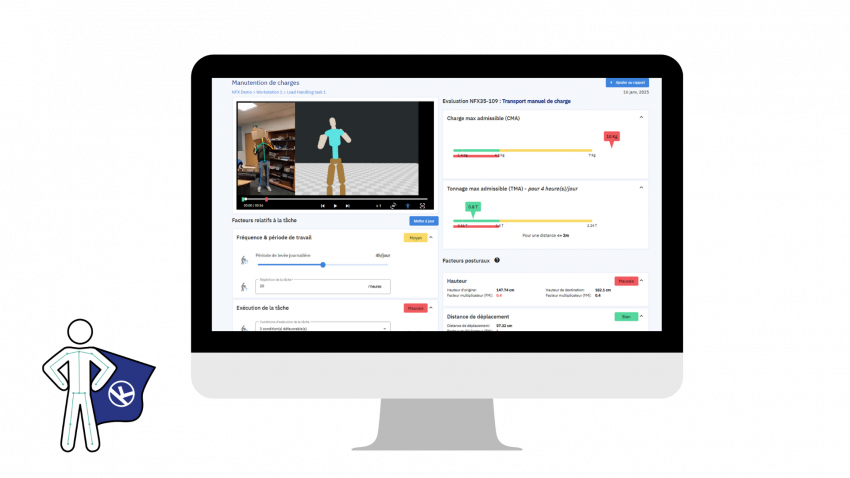
To go further, tools such as KIMEA Cloud enable you to centralize and analyze data related to MSD risks, facilitating the assessment and monitoring of actions.
- Collection and analysis of biomechanical indicators for each workstation
- Prioritization of actions based on actual identified risks
- Traceability, monitoring, and support for feeding into the DUERP and PAPRIPACT
- Support for social dialogue with objective data to be presented to the CSE as well as to various stakeholders: management, employees, etc.
Manage your prevention approach at every stage with KIMEA Cloud.
Sources :
Juritravail – Papripact & DUERP https://www.juritravail.com/Actualite/sante-et-securite-au-travail-une-obligation-de-resultat-pour-l-employeur/Id/374754#:~:text=Ainsi%2C%20en%20pratique%2C%20le%20Code,puis%20les%20combattre%20(Papripact).
Légifrance – Accord du 18 juin 2024 relatif à la santé et sécurité au travail https://www.legifrance.gouv.fr/conv_coll/article/KALIARTI000050298561#:~:text=Le%20PAPRIPACT%20est%20un%20document,proposer%20les%20actions%20pr%C3%A9ventives%20n%C3%A9cessaires.
Légifrance – Article L2312-27
https://www.legifrance.gouv.fr/codes/article_lc/LEGIARTI000035609816
Légifrance Article L2317-1 https://www.legifrance.gouv.fr/codes/article_lc/LEGIARTI000035634273
Légifrance – Article L4121-3-1 https://www.legifrance.gouv.fr/codes/article_lc/LEGIARTI000043893919
Légifrance – Article R4121-2 https://www.legifrance.gouv.fr/codes/article_lc/LEGIARTI000045386446