


S.E.C. and KIMEA: Measure, adjust, improve
Société d’Exploitation de Carrières (S.E.C.) is a local construction materials company operating in the Alpes-Maritimes French department and owned by the Vinci and Cemex groups.
With several sites across the region, the company supports construction and public works professionals by offering a wide range of aggregates and reformulated materials made from both primary and secondary resources, including OGÊO, while also developing recycling and recovery activities for waste generated on construction sites.
For many years, S.E.C. has been committed to sustainable development and the circular economy through its “Granulat +” approach.

Société d’Exploitation de Carrières : key figures
Among its various sites, the Villeneuve-Loubet site employs around ten people and is managed by Stéphane Masson, Site Operations Manager.
His role is to oversee the site’s operations across all areas, including human resources, quality, safety, health and production, with one key objective: to ensure the best possible working conditions for employees while meeting customers’ needs.
A prevention approach already underway, strengthened by data
Before starting the initiative with Moovency, S.E.C. had already undertaken significant prevention efforts. The site was supported by its occupational health service, including an ergonomics-trained occupational health nurse who was familiar with the working environment and the feedback received from employees.
S.E.C. wanted to involve these stakeholders in the initiative in order to combine their on-the-ground knowledge and existing assessments with the analyses provided by Moovency. The objective was to compare the different findings, verify that they were consistent, and ensure that the prevention measures already underway were moving in the right direction.
The idea was to work with KIMEA, which is a very visual and practical tool to use, together with qualified professionals, both the Moovency team and the occupational health service, who know our employees and understand our needs and expectations.
Stéphane MASSON
Operations Manager, S.E.C. Villeneuve Loubet
The initiative has also led to exchanges with other S.E.C. sites and entities within the VINCI Group, particularly with a view to sharing videos and comparing certain work situations.
The starting point: four priority workstations identified
At the Villeneuve-Loubet site, four workstations had been identified prior to the initiative with Moovency as involving specific physical demands: the laboratory, sorting, Big Bag production and the weighbridge.
The Laboratory: repetitive handling and load carrying
S.E.C. processes two types of resources: primary resources (quarrying) and secondary resources, i.e. materials from demolition and earthworks sites. These materials are then sorted, crushed and screened to produce different aggregate sizes, which are used in particular by ready-mix concrete plants and asphalt mixing plants.
At the site, the laboratory plays a key role in monitoring these materials. Technicians carry out weekly sampling to check the grading and quality of the aggregates, in compliance with CE 2+ marking requirements.
As a result, this activity involves a significant amount of handling. Technicians collect samples from the various production sites, with nearly ten bags per site, some weighing up to 25 kg. These bags are handled several times throughout the process: sampling, loading into the vehicle, unloading at the laboratory, preparing and separating the samples, and then carrying out the analyses.
Three other priority workstations
In addition to the laboratory, three other workstations had been identified: sorting, Big Bag production and the weighbridge. Each involved different physical demands.
Illustration of the physical constraints at the weighbridge
Video credit S.E.C.
Other situations, particularly maintenance activities involving the handling of heavy parts in sometimes confined spaces, were also among the areas S.E.C. wanted to explore in greater depth.
S.E.C.’s objective was therefore to have an approach that would help better objectify the physical demands associated with these different workstations, prioritize the situations requiring attention, and guide prevention measures.
From analysis to action: testing improvements in the field
Trained to use the tool in September 2025, Stéphane Masson, together with the occupational health nurse, began by analyzing the laboratory workstation, which was chosen as the first case study because it was both easily accessible and particularly representative of the issues encountered. Following this initial analysis, the team continued recording footage at the sorting area, the Big Bag workstation and the weighbridge.
These issues were addressed and solutions were implemented. Extensive follow-up work was carried out through before-and-after comparisons to assess their effectiveness.
Stéphane MASSON
Operations Manager, S.E.C. Villeneuve Loubet
The team also compared several configurations of the weighbridge workstation with a colleague from another VINCI Construction entity. This work showed that a change designed to improve working conditions does not necessarily produce the expected outcome.
The value of the approach therefore lies as much in identifying physical demands as in being able to test different configurations and assess their effectiveness before implementing them.
In practice: testing, adjusting and measuring results
Stéphane Masson shares a few concrete examples of configurations implemented at the Villeneuve-Loubet site.
At the weighbridge: when an improvement initially worsens the score
Credit : S.E.C.
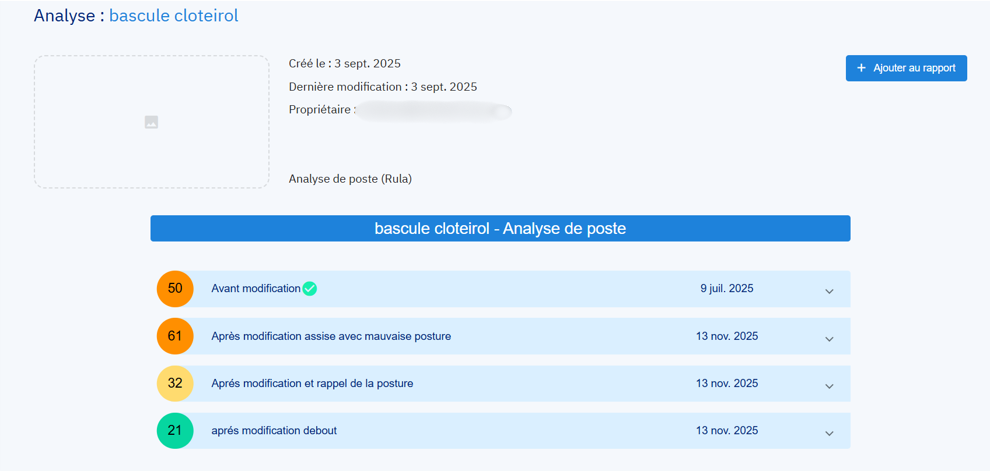
The weighbridge workstation underwent a significant transformation: the team replaced the cabin to adjust the height of the window and installed a sit-stand desk, along with an adjustable chair allowing the operator to adapt her position.
However, the first measurement after these changes came as a surprise: the KIMEA risk score increased from 50 to 61, indicating a deterioration in the situation.
The team then reviewed the footage and analyzed the operator’s movements and postures in greater detail. They found that, despite the new furniture, the operator was sitting too far away from the workstation and was still adopting a physically demanding posture.
A further phase of support and workstation adjustments brought the score back down to 32. Then, after testing the desk in the standing position, the score dropped further to 21.
This example illustrates the value of having an objective measurement: a solution that seems relevant in theory does not necessarily guarantee an improvement in practice.
At the Big Bag workstation: completely rethinking the solution through analysis
The same approach was applied to the Big Bag production workstation. To reduce the physical demands associated with repeatedly tying knots on the handles, S.E.C. initially purchased a strapping tool, a machine designed to automatically secure the handles using wire.
But once again, the initial result was not what had been expected: the score increased from 33 to 53. A detailed analysis of the situation showed that the operator had to retrieve the machine, move it and bring it back for each operation, thereby introducing additional physical demands.
S.E.C. therefore modified the setup. The machine was suspended using an elastic cord (bungee cord) and positioned directly where the operator needed to carry out the strapping operation. The operator could then pick up the machine, perform the task and release it without having to move it.
This new configuration resulted in a score 6 points lower than the initial level.
Without KIMEA, we probably wouldn’t have identified this issue. We would have implemented a corrective action without necessarily looking any further into the analysis. Moovency’s contribution was therefore a real asset to this approach.
Stéphane MASSON
Operations Manager, S.E.C. Villeneuve Loubet
Here, we show them the video with the different segments. There’s no need to explain anything: they can see for themselves when they move into the red zone, or how often they’re in the orange zone because they’re leaning like this. It’s engaging.
Stéphane MASSON
Operations Manager, S.E.C. Villeneuve Loubet
Through these two concrete examples, Stéphane Masson highlights the value of visual feedback. For him, this was one of the factors that convinced him when he first discovered Moovency: employees are not watching a theoretical demonstration; they see their own activity and their own movements.
The approach also extends to office workstations
S.E.C. also assessed the working conditions of office-based employees, asking them to record some of their daily activities: working at a computer, using the phone, and answering and ending calls.
With support from the occupational health service, several areas for improvement were identified, particularly in relation to workstation setup and equipment. Central computer mice were also tested, although adoption was more limited.
An approach that requires a few practical guidelines
Recording the videos required some adjustments, particularly to find the right camera angle for workstations where employees move around frequently.
The two main challenges I initially had with KIMEA were getting the recording right and finding the right angle to make sure all the segments could really be seen. That was a bit tricky because people move around a lot, and sometimes they turn around… On the day of the training, we had two people performing the same task. We started with the first person, adapted to the way they worked, and assumed the second person would work in the same way. But that wasn’t the case at all: they worked in a completely different way. So you really have to find the right angle, because people move around a lot.
Stéphane MASSON
Operations Manager, S.E.C. Villeneuve Loubet
A challenge that Stéphane Masson now sees as part of the learning process: recording at the right time and from the right angle gradually becomes second nature, particularly when work situations are highly dynamic.
Going further: a long-term approach
The initial results achieved at Villeneuve-Loubet have encouraged Stéphane Masson to take the approach further. Several other work situations have been identified, particularly in maintenance, but their analysis has not yet progressed as far. Between team availability, intervention schedules and the time required to record footage and carry out the analyses, it is not always easy to have the right conditions in place at the right time.
Among the next areas identified, automating the opening and closing of the weighbridge window is a priority: this movement can be repeated up to 150 to 200 times a day on the busiest days.
The laboratory also remains an area for experimentation. S.E.C. is currently working on a prototype designed to reduce the handling involved in sample quartering (splitting). New footage will be recorded to compare this configuration with the initial situation.
And above all, a commitment to changing the way work is done
Ultimately, for Stéphane Masson, the approach goes beyond simply analyzing workstations. It reflects a broader conviction: physical demands should not be seen as an inevitable part of the job, and technical solutions should be used to make work easier wherever possible.
We have to make these solutions accessible to people. Today, we can’t just say, “You’re going to carry 50-kilo bottles by hand.” We need to keep moving in that direction and continue making progress.”
Stéphane MASSON
Operations Manager, S.E.C. Villeneuve Loubet
This ambition is supported by a broader context within S.E.C. and VINCI, where health and safety issues are closely monitored and there is a strong openness to future initiatives. Stéphane therefore sees the approach as an opportunity to go beyond his own site and share experiences and solutions with other sites facing similar challenges.
The added value of KIMEA: making physical demands visible and easy to understand
For Stéphane Masson, KIMEA’s added value lies in its ease of use and the speed at which it provides an initial assessment.
For some more in-depth analyses, he was also able to rely on the support of Mathieu, an Ergonomist at Moovency, to fine-tune certain parameters and interpret the results.
The future of health and safety: using data to keep improving
For Stéphane Masson, health and safety issues will continue to grow in importance in the years ahead. In this context, having tools that provide objective, visual insights is an asset for field teams.
For me, this is a real asset for the future of health and safety. It’s very clear, it’s factual, and that’s what we need when working with our teams in the field. Having tools like these, which are relatively simple to use, also allows us to keep improving.
Stéphane MASSON
Operations Manager, S.E.C. Villeneuve Loubet
A big thank you to Stéphane Masson for sharing his experience, as well as to all the teams and partners involved in this initiative. Thank you for your trust!