


Capitalization of technical gestures with KIMEA: The story of GSF
Founded in 1963, GSF is a company specialising in cleaning and services solutions, renowned for its expertise in environments with high standards. The group works with a wide range of clients in many different sectors, including:
- Agri-food
- Industry
- Nuclear
- Pharmaceuticals
- Health and care
- Retail spaces
- Tertiary sector
- Transport
These environments, which are often sensitive, require specific technical knowledge and a detailed understanding of each customer’s specific requirements. GSF draws on its operational know-how to guarantee the quality, safety and compliance of its services.
Key figures
→ The first company in the sector to obtain triple QSE certification
→ An international presence: United States, Canada, and United Kingdom
→ A European partner network (ECS) for clients seeking consistent service quality across their European sites.
GSF’s R&D department
At the heart of the GSF environment is Marie Battreau, a food engineering graduate and ergonomics trainee. She has been part of GSF for 23 years, working within the agri-food division of the Research & Development (R&D) department, which consists of nine team members.
The R&D department functions as an internal support unit whose role is to assist the operations teams, referred to internally as “exploitation”, which directly manage the cleaning staff on client sites. The R&D team ensures that operational teams have clearly identified client expectations, while also supporting them commercially (by helping draft proposals) and operationally, by conducting service audits and implementing specific training programs.
Beyond this support role, the R&D department, as its name suggests, is also responsible for innovation and service optimization in the cleaning and facility services sector, constantly seeking to improve methods and on-site practices. This work is cross-functional and spans several specialized divisions. Marie Battreau contributes specifically to the agri-food division, in line with her professional expertise.
As part of her role, she makes numerous recommendations, including recommendations on equipment, chemical products, and working methods, with particular attention paid to operator safety, although a dedicated department at headquarters manages safety in the strict sense.
Through its role as advisor, auditor, and trainer, the R&D department therefore provides both technical expertise and professional best practices. It not only transmits working methods, but also professional standards and good practices. It is also here that the initial reflection on ergonomics began, particularly regarding how to reduce the physical strain experienced by operators in their daily work.
A focus on cleaning in the agri-food sector
In the agri-food sector, GSF operates at a wide variety of industrial sites, ranging from meat to vegetables, biscuits and beverages.
Today, the group is present at more than 380 industrial sites, and agri-food accounts for 11% of GSF’s total turnover.
Detailed breakdown of Agri-food revenue
Cleaning in this sector is particularly demanding and is based on two main complementary methods:
→ Cleaning of open surfaces: this involves removing visible dirt from accessible surfaces.
→ Cleaning closed surfaces: this includes tanks or equipment that can be cleaned at any time of day. This type of cleaning is less often outsourced and requires special expertise.
Before KIMEA: The challenge of sometimes tedious ergonomic studies
Within the group, a MSDs prevention initiative has existed for several years, led by the Integrated Management System (IMS) department and Margot Lecaque, the health, safety, and MSD prevention officer. For many years, workstation studies have been conducted by APTMS facilitators* in the agri-food sector.
For the past three years, Marie Battreau and one of her colleagues, Rémi Canepa, have been working on this topic with internal subject-matter experts and the IMS team. In the field, they quickly observed that operators were experiencing back problems, carpal tunnel pain (“the notorious pinch”), and other signs of fatigue caused by the repetition and difficulty of certain tasks.
Some practices even showed improvised adaptations, sometimes risky: certain operators modified their cleaning tools—for example, by attaching cable ties to spray guns to make them easier to use—which could introduce additional hazards.
APTMS: Facilitators for the Prevention of Musculoskeletal Disorders (MSDs) (French version : Animateurs de la Prévention des Troubles Musculosquelettiques (TMS)).
And we could clearly see in the field, with our audits, that we had worn-out people. We asked ourselves: “How are these operators going to age with all this?”
Marie BATTREAU
R&D Engineer and Ergonomics Trainee
A first macro-level analysis was launched with several collaborators who were well acquainted with the agri-food sector. However, the exercise proved more challenging than expected, as each collaborator had their own responsibilities, making it difficult to make progress. The available data were insufficient and not fully representative of on-site reality. To address these limitations, an additional resource was mobilized: a work-study student, Benoît Caron, who worked on the project for a year. Despite this support, the analysis remained tedious and time-consuming.
The internal training program to become an APTMS facilitator requires breaking down each operator’s activity to analyze their movements. This is a lengthy process and impractical to apply to all operators, given the diversity of roles and tasks.
I was well aware that everyone knows how to lift and carry a box. Everyone knows this, but in our sector, we don’t have any specific movements that are identified as “know-how”. We know how to give advice, for example by saying that you should start with a particular machine or tool, but in practical terms we didn’t tell them how to do it in terms of gestures and postures.
Marie BATTREAU
R&D Engineer and Ergonomics Trainee
Consequently, aware that it was difficult to analyse everything, especially given the specificities of each work situation, Marie and Rémi wanted to use a tool that would help them save time in identifying best practices.
It was in this context that they turned to Moovency and KIMEA to obtain objective and representative results and move forward more effectively and confidently in their prevention efforts.
With KIMEA: From mapping project to operational database creation
Since the end of 2024, Marie and her work-study student have started using KIMEA as part of a large-scale project aimed at mapping cleaning activities in wet areas.
The tool was quickly adopted with a clear objective: to create a dedicated agri-food database that could be used by all GSF teams for both cleaning operations and service delivery.
For an operation such as floor cleaning or low-surface cleaning, four categories of solutions can be mobilized:
“Work methods and Job techniques” solutions
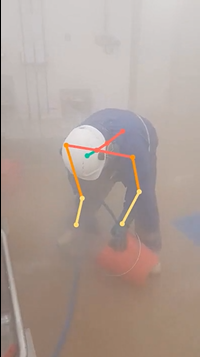
Photo credit: GSF
They remind operators of the expected best practices: maintaining a straight back, getting closer to the surface by kneeling rather than bending from a standing position, and so on.
“Tool” solutions
These may include, for example, the use of knee pads, or cleaning stations designed to work at height, avoiding tasks performed directly on the floor.
“Organizational” solutions
These involve different ways of structuring the workflow to reduce the duration or frequency of floor-level work.
“Client-related” solutions
Teams are dependent on the environment in which they operate. This includes interactions with the client, such as task allocation, environmental adjustments, or specific accommodations. These discussions can take place upfront during contract negotiation or during service delivery.
This allows the entire GSF Agri-Food community to access these recommendations directly. Thus, when a team wants to conduct an MSD prevention study at their site, they can draw from the IMS library of best practices and adapt them to local specifics.
This approach facilitates the capitalization of analyses, the standardization of practices, and the rapid dissemination of effective solutions across the network. It also provides a more detailed view of various operations, almost like “activity chronicles.”
Sometimes, we have a team of five operators and we wonder where to start. Moovency allows me to film each person, view their scores and decide who to focus on first. For each operator, we can identify which part of their job to analyse first. As our cycles are long and varied, rather than repetitive, the tool also helps us to detect the most critical activities. I therefore see a lot of value in using it.
Marie BATTREAU
R&D Engineer and Ergonomics Trainee
KIMEA at the heart of Human interactions
Beyond its technical aspect, KIMEA has primarily helped bring teams together and create a space for dialogue around field practices.
The tool provided a shared basis for observation and analysis, facilitating exchanges between operators, supervisors, and subject-matter experts. These very concrete feedbacks made it possible to co-develop the solutions described above: work methods and job techniques, tools, organizational adjustments, and so on.
These are solutions that have been passed on to us, solutions from the field.
Marie BATTREAU
R&D Engineer and Ergonomics Trainee
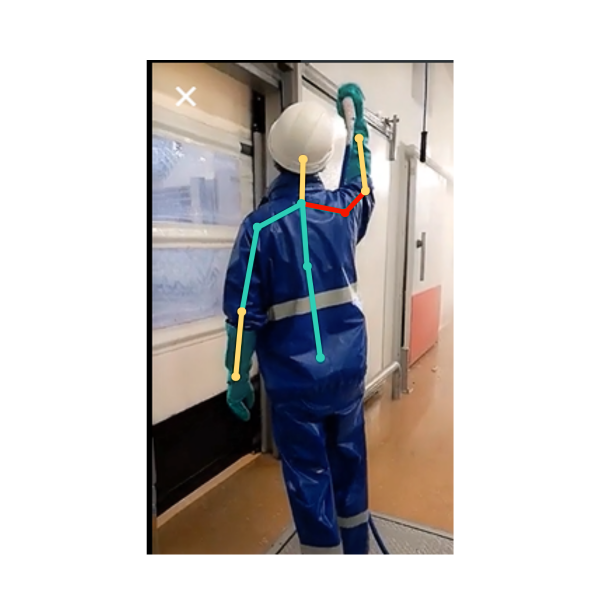
Photo credit: GSF
KIMEA thus became a central platform for exchange. With a particularly large and experienced agricultural community, Marie and her team were able to interview around fifteen people about their preservation or regulation techniques in specific situations.
KIMEA made it possible to illustrate the scene precisely, compare practices, and come up with solutions based directly on the operators’ experience.
Highlighting Professional Expertise
Through the interviews conducted, Marie and her team gathered a significant amount of field feedback. All of this material is currently being synthesized, with a clear objective: to integrate these best practices into future internal training programs. Two internal trainers are already involved in this project and will ensure the dissemination of these practices once the training materials are finalized.
Beyond the content itself, this approach has helped create genuine “sponsors”. Everyone consulted during the interviews played a key role, participating through a remote working group where each person was able to contribute according to their capacity.
These people were proud to be able to share their preservation techniques, which showcased their expertise, something we had never had the opportunity to explore before.
Marie BATTREAU
R&D Engineer and Ergonomics Trainee
This sharing also made it possible to mobilize a wide range of profiles: active operators, supervisors, and even a retiree, happy to be consulted on his accumulated expertise. One question came up repeatedly during the interviews:
“How did you identify this preservation technique?”
→ “Through experience.”
And this is precisely where the challenge lies: GSF has highly skilled employees, but they are spread across different sites, and their empirical expertise has been built over many years… sometimes at the cost of physical strain.
As Marie summarizes: We cannot wait for everyone to wear themselves out “through experience” to discover the right techniques. Our goal is for newcomers to have them from the start.”
Early Benefits: A shift in perspective already underway
At this stage of the project, concrete results on the ground are still too early to report. Data compilation and dissemination are ongoing, which means the full operational impact cannot yet be measured. However, significant benefits are already being felt, particularly in terms of human, organizational, and relational aspects.
Simply communicating about the project and engaging a broad range of stakeholders (operators, supervisors, and subject-matter experts) has helped overcome an initial barrier: the sense of distance from the topic. It’s no longer an “external” subject, but a shared, understood, and appropriated issue among a diverse set of profiles, built through co-construction.
Client Benefits
Another major benefit concerns client relationships. As a service provider, the expectations are high, especially in the agri-food sector. Impeccable cleanliness is required, even in the most hard-to-reach areas, such as underneath machines, a task often invisible to clients.
Marie perfectly illustrates this invisibility of work:
“It’s a bit like buying a t-shirt from China: you don’t necessarily think about who made it. For agri-food products, it’s the same. If smoked salmon comes out of a factory ready to eat, it means an operator had to lie on the floor to clean under a machine.” This is a reality that some clients do not want to see, or even imagine.
Thanks to this project and KIMEA, the perception of cleaning work is evolving. Clients are becoming more aware of awkward postures, the effort required, and the acceptable limits. They better understand why certain requests can be difficult, or why specific accommodations are necessary.
This project has already helped raise awareness, foster mutual understanding, and enhance recognition of the real work, both internally and with clients. It is a key first lever for ensuring future success.
The Added Value of the tool ?
For Marie, the real added value of KIMEA can be summed up in two words: efficiency and credibility.
KIMEA has enabled the team to be more effective in analyzing their cleaning activities, handling a large number of situations with numerous operators. This makes the results more representative and legitimate when shared.
Key learnings from using KIMEA : beyond analyzing video data, KIMEA has enabled us to observe and discuss operator postures with supervisors or directly with the operators themselves, and to explain the proper ways of working. It became clear that operators want to see what they are cleaning and to be close to the surfaces they are working on. However, due to lack of experience, environmental constraints, or the use of poorly adapted tools, they sometimes adopt awkward postures in order to clean effectively.
Marie BATTREAU
R&D Engineer and Ergonomics Trainee
What does the future hold for the tool at GSF?
For Marie, the next step is to extend the study to the “dry” agri-food sector, particularly in biscuit production, where cleaning relies on scraping, vacuuming, and manual wiping. The goal is to gradually cover the entire agri-food sector by the end of 2026 – early 2027.
More broadly, the expansion of KIMEA to other GSF branches or sectors is still to be determined. For now, no official decision has been made, but the tool is generating growing interest.
A big thank you to Marie BATTREAU for her insightful and authentic testimony, and to the GSF teams for their commitment and trust in using KIMEA!