


Bending, twisting and repetition: a high-risk combination for MSDs in logistics?
Logistics is a dynamic sector at the heart of the modern economy — but also one of the most exposed to musculoskeletal disorders (MSDs). These disorders, often silent, have a significant impact on workers’ health, company performance, and social costs.
MSDs include conditions affecting muscles, tendons and joints, often linked to constrained movements (bending, twisting) and to the repetition of similar tasks.
Key figures on MSDs in logistics
High prevalence in the sector
93% of recognized occupational diseases in the transport and logistics sector are MSDs.
Impact on health and work
28% of workplace accidents in logistics are related to back pain. Back pain accounts for 1.3 million lost working days per year, equivalent to 2,000 full-time jobs.
Economic cost
Companies pay approximately €61 million per year to cover MSD-related claims in the transport and logistics sector. An additional €140 million in social security contributions must be added, not including indirect costs.
In concrete terms, MSDs are not just cold statistics: they result in sick leave, daily suffering, and a very real cost for both companies and society.
A critical combination: bending, twisting and repetition
In logistics, certain biomechanical risk factors are especially significant:
Repetition
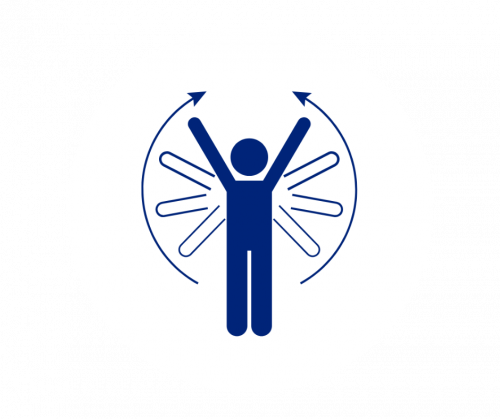
Picking, handling, and moving packages are repeated hundreds of times a day. This repetition causes gradual tissue wear, especially when it involves the same joints and muscles.
Excessive bending
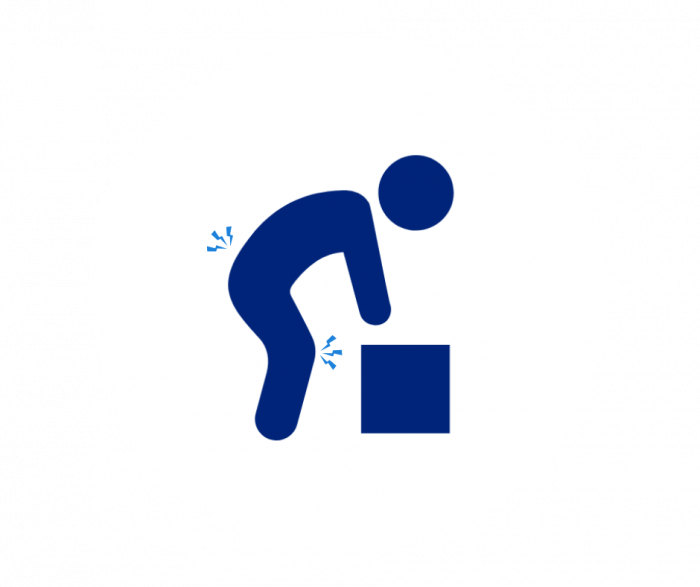
Working with the back, knees, or arms bent — especially when handling packages at varying heights — increases pressure on the spine and joints.
Twisting
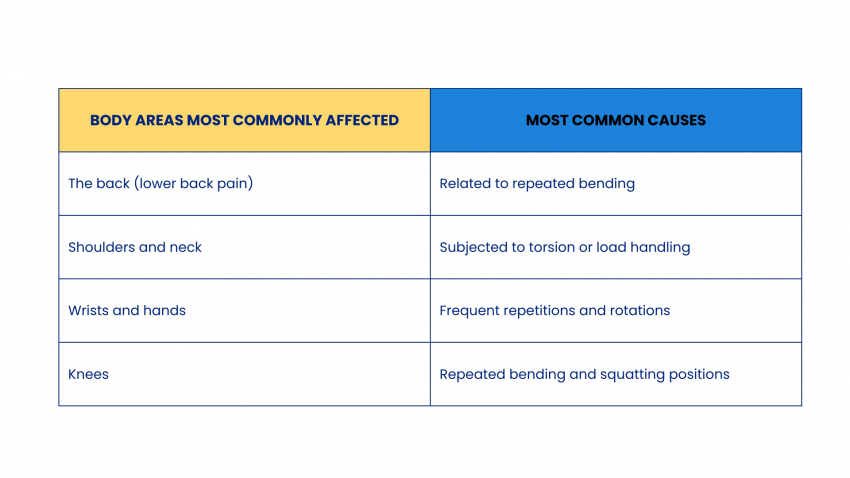
Twisting of the trunk and limbs (e.g., pivoting with a load, wrist rotation) is particularly aggravating because it engages multiple muscle and tendon groups simultaneously, increasing the risk of tendinitis, lower back pain, or carpal tunnel syndrome.

These three types of strain add to other awkward postures, such as arms raised above shoulder level, a bent back, etc. and to the lifting or moving of heavy loads, all of which are typical in many logistics roles.
Why the combination of bending, twisting, and repetition is particularly risky
Individually, each of these factors already poses a risk to the musculoskeletal system. But in logistics, they often occur together, which amplifies their impact on the body and accelerates the development of MSDs.
> Repetition: a silent but continuous wear
In warehouses and logistics hubs, operators often perform several hundred, or even thousands, of similar movements per day: grasping, pulling, pushing, placing, scanning, stacking.
This repetition continually strains the same muscles, tendons, and joints, with little time for recovery.
The result:
-
the development of micro-lesions that are invisible in the short term,
-
a gradual decrease in tissue recovery capacity,
-
chronic inflammation of tendons and tendon sheaths.
Unlike a sudden accident, repetition acts like mechanical wear. Pain develops gradually, is often overlooked, and can eventually become chronic (tendinitis, carpal tunnel syndrome, epicondylitis).
> Bending : a biomechanical overload on the body
Bending, especially of the back, is omnipresent in logistics: picking up a package from the floor, placing a load on a low level, working on pallets.
When the back is bent, the pressure on the spine increases significantly.
Some illustrative benchmarks:
-
Trunk bending can double or triple the load on intervertebral discs,
-
When combined with a load, this pressure increases even further,
-
Repeated daily, it contributes to lower back pain, disc herniation, and chronic lumbar discomfort.
In addition, prolonged or repeated bending excessively strains the lower back muscles and knees, leading to muscle fatigue, reduced stability, and an increased risk of injury.
> Twisting: an often underestimated aggravating factor
Twisting of the trunk or limbs occurs when an operator pivots to place or move a load without moving their feet, or when rotating the wrist while handling packages.
The problem with twisting is that it:
-
creates asymmetrical stress on the joints,
-
disrupts muscle force balance,
-
heavily strains tendons and ligaments.
When applied to the spine, twisting significantly increases the risk of injury, especially when combined with bending or lifting. At the upper limbs, it contributes to shoulder, elbow, and wrist tendinopathies.
The bending–twisting–repetition trio is even more hazardous in a context of:
-
high work pace,
-
productivity pressures,
-
lack of breaks or task rotation,
-
poorly designed workstations not optimized for operators.
Under these conditions, operators adopt compensatory strategies (poor postures, fast movements), which further increase the strain on their bodies.
Conclusion
The bending–twisting–repetition trio is not just an expression — it reflects the interaction of biomechanical stresses that explain why MSDs dominate the logistics sector. These disorders carry a significant human and economic cost and remain the leading cause of occupational diseases in the industry.
However, with better prevention measures, clear communication between teams, a more ergonomically-focused work organization, and a strong occupational health culture, their impact can be significantly reduced.